Insurance Roof Replacement: What Adjusters Actually Approve vs. What Homeowners Expect (2026 Guide)
August 11, 2026
How does an adjuster actually decide what they’re willing to pay for? It’s not a simple yes‑or‑no. A roof claim is a layered decision built from policy language, cause of loss, scope, pricing methodology, depreciation math, and local building codes stacked like shingles. Homeowners who understand that stack stop arguing about “coverage” in the abstract and start focusing on the five or six specific variables that actually move a settlement number.
This guide explains how roof insurance coverage really works, where insurers and homeowners most often disagree, how to document damage in a way that holds up, and what your options are when a claim is denied or reduced.
None of this replaces a conversation with your insurance agent or a licensed public adjuster about your specific policy. It's meant to make that conversation more informed.
Key Takeaways
- Actual cash value (ACV) and replacement cost value (RCV) determine whether depreciation is subtracted from your payout, and many insurers now switch aging roofs from RCV to ACV coverage at renewal, often without homeowners noticing.
- Homeowners insurance covers sudden, accidental damage from a covered peril, such as wind or hail damage, falling trees, fire, not gradual wear and tear, poor roof maintenance, or a roof nearing the end of its expected lifespan.
- Adjusters and roofing contractors frequently disagree on scope, not honesty. The disagreement usually comes down to whether a roof repair is possible or a full replacement is required, and how depreciation and code upgrades get calculated.
- Documentation, from before the damage occurs through the adjuster's visit, is often the single biggest factor in whether a claim is approved at full scope or settled at the minimum.
- A denial or reduced payout is a starting point, not a final answer. Reinspection requests, itemized supplements, and the policy's appraisal clause all exist specifically to resolve these disputes.
- Ordinance or law coverage, a frequently overlooked policy add-on, is often the only coverage that pays for code-required upgrades triggered by a roof replacement, and standard dwelling coverage usually won't.
What Your Deductible Really Means
Your deductible is your share of the cost. It’s the amount you agree to pay out of pocket before insurance kicks in.
It comes out of the first check. When the adjuster calculates the Actual Cash Value (ACV), they subtract depreciation and your deductible before sending the initial payment.
For Example:
- Replacement cost: $15,000
- Minus depreciation: $6,000 → ACV = $9,000
- Minus deductible: $2,000 → First check = $7,000
Depreciation (the “holdback”) is paid later once repairs are finished, and proof is submitted. The deductible never comes back; it’s always your responsibility.
If your first check feels smaller than expected, it’s because the deductible is taken out right at the start.
How Roof Claims Are Actually Evaluated
Forget the brochure version of "what your policy covers." Before an insurance company pays, a claim must pass a series of internal checkpoints. Skip past this sequence, and you'll misread every letter your insurance provider sends you.
Step 1: Confirming a Covered Cause of Loss
Not every roof with visible damage has an insurable loss attached to it. This is the single most misunderstood idea in the entire claims process, and it's where the phrase covered peril starts to matter.
- A covered event typically includes things like hail, straight-line wind or wind damage, a tornado, fire, or a falling tree.
- What it rarely includes: deterioration, thermal cracking, manufacturing defects, improper installation, or deferred maintenance.
Insurance is designed to respond to sudden, accidental, external events, not to the slow decline that comes from an aging roof simply doing what aging roofs do.
This is where causation becomes a technical battlefield. Two adjusters can stand on the same roof, see the same granule loss, and reach opposite conclusions; one calling it hail damage, the other calling it normal wear and tear. Both are trained professionals. Both are looking at the same shingles. The disagreement isn't about honesty; it's about interpretation, and interpretation is where claims get won or lost.
Step 2: Determining Functional vs. Cosmetic Damage
Adjusters don't stop at "Is this hail damage?" They ask a second, sharper question, like, does this damage actually impair function, or does it just look bad?
That distinction shows up constantly:
- Metal roof denting is often cosmetic, rarely functional, and rarely a driver of full replacement on its own.
- Asphalt shingle bruising is the soft spots from hail impact that may not leak today, but compromise the mat underneath.
- Granule displacement is cosmetic in small amounts, functional once it exposes the asphalt layer to UV breakdown.
- Creased shingles are a wind signature that often means the seal strip has already fractured, even if it hasn't visibly lifted yet.
- Fractured seal strips are arguably the most important item on this list, because a broken seal is an invisible failure point that shows up as a leak eighteen months later.
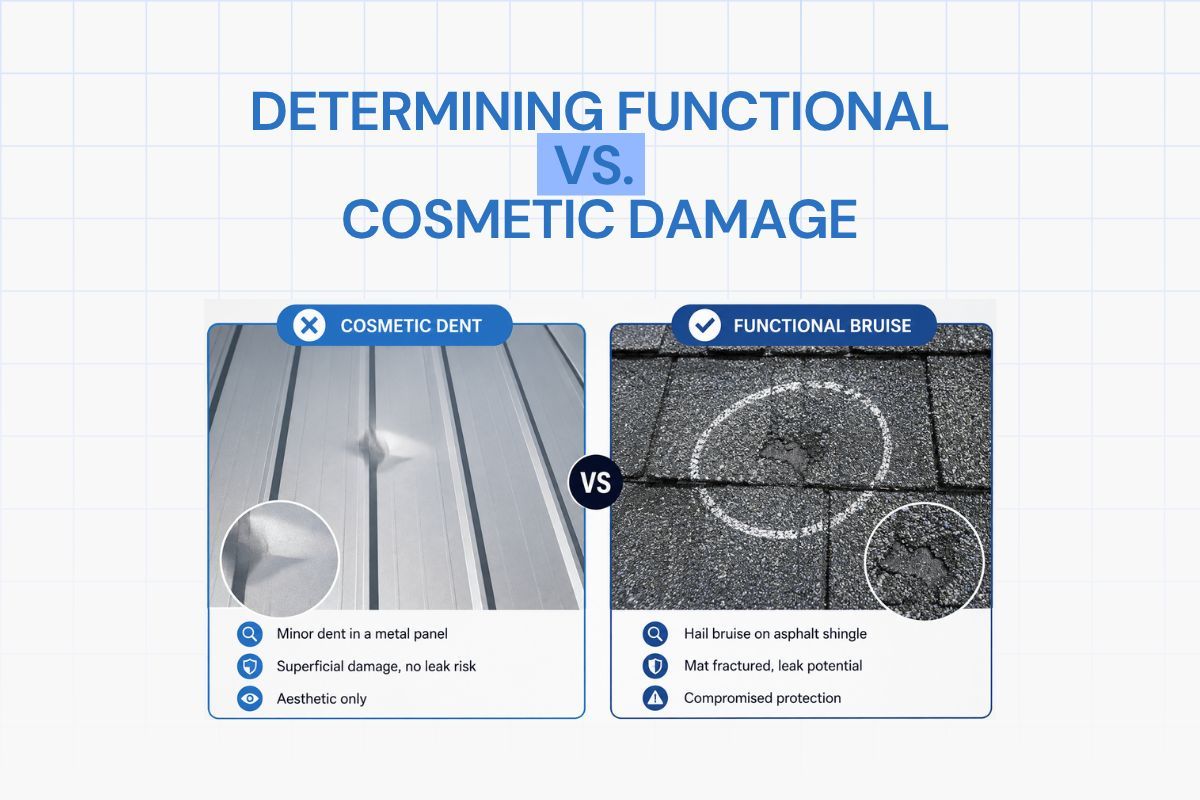
Cosmetic damage carve-outs are one of the most contested clauses in a modern homeowners' policy, especially on metal roofs, and it's worth reading that exclusion line by line before you ever file.
Step 3: Determining Repairability
This is where full roof replacement claims are actually won or lost, and it deserves its own conversation, not a footnote.
An adjuster (and any reputable roofing contractor worth hiring) can ask a specific set of questions, like:
- Can the damaged shingles physically be replaced without breaking three more in the process?
- Will a patch repair compromise watertightness on a slope that's already lost flexibility with age?
- Are matching roofing materials even still manufactured, or was that shingle line discontinued five years ago?
- Can the surrounding, undamaged shingles be lifted and re-sealed without cracking, given how brittle an older roof gets?
If the honest answer to those questions is "not reliably," repair stops being a real option, and that's the door that opens toward full replacement.
For the full picture on costs after evaluation, check our insurance roof replacement guide.
Policy Language That Changes the Entire Claim
The difference between two nearly identical roof damage claims often isn't the storm. It's four or five sentences buried in the policy itself.
1. Replacement Cost vs. Actual Cash Value
This is the fork in the road that determines everything downstream, and most homeowners don't actually know which side of it they're standing on until a claim is already open.
- Replacement cost value (RCV) pays what it costs to install a comparable new roof today, full stop.
- Actual cash value (ACV) pays that same number minus depreciation for the roof's age and condition, meaning an older roof might only be worth a fraction of what a brand-new one costs to install.
Let’s put the numbers into action; here’s how depreciation and your deductible shrink the first insurance check on a $15,000 roof claim.
| Step | Description | Amount |
|---|---|---|
| Replacement Cost (RCV) | What it costs to install a comparable new roof today | $15,000 |
| Depreciation (10 years of wear) | Value lost due to age and condition | − $6,000 |
| Actual Cash Value (ACV) | Roof’s value right before the loss | $9,000 |
| Deductible | Homeowner’s out‑of‑pocket share | − $1,000 |
| First Check (ACV minus deductible) | Initial payment from insurer | $8,000 |
| Holdback (Depreciation) | Paid later after repairs are complete | +$6,000 |
| Final Total Payout | Full replacement cost once work is verified | $14,000 |
Here's the part most articles skip: even on an RCV policy, insurers usually hold back recoverable depreciation and only release it after the work is completed and paid for. If depreciation is instead classified as non-recoverable, that money is simply gone, and the homeowner absorbs it regardless of when repairs happen.
Insurers are increasingly attaching age-based endorsements that quietly shift roofs past a certain age onto ACV-only settlement, no matter what the base policy promises. If your roof is older, this is the clause to hunt for before a storm ever hits, not after.
2. Roof Surface Payment Schedules
This is one of the more consequential shifts happening in homeowners' insurance right now, and very few consumer-facing articles even mention it.
Instead of calculating traditional depreciation, a growing number of policies now pay out roof coverage according to a fixed percentage schedule tied directly to the roof's age and material.
- A ten-year-old asphalt roof might be capped at a set percentage of replacement cost regardless of its actual remaining lifespan, while a newer or metal roof sits in a different bracket entirely.
If you haven't checked whether your policy uses one of these schedules, it's worth a phone call to your insurance agent, because it can override everything you assumed about your dwelling coverage.
3. Matching Endorsements and Matching Statutes
Here's a scenario that plays out constantly: hail hits one slope of a roof, and the insurance company offers to pay for that slope only. The homeowner points out that the new shingles won't match the old ones anywhere close. Who wins?
It depends almost entirely on geography. Some states have matching statutes or regulatory guidance requiring "reasonable" uniformity in appearance; others leave it to the specific matching endorsement language in the policy, if one even exists.
This is a genuinely underexplained corner of roof insurance claims, and it's exactly the kind of detail that separates a homeowner who negotiates well from one who accepts the first number offered.
4. Ordinance or Law Coverage
Building codes change. Roofs installed a decade ago often don't meet current requirements, and once a replacement is triggered, code compliance frequently becomes mandatory, whether the base policy anticipated it or not.
This is where ordinance or law coverage earns. It keeps covering upgrades like ice barrier installation, correctly spaced drip edge, updated ventilation, proper sheathing fastening patterns, and secondary water barriers.
None of these is a cosmetic upgrade. They're code-driven requirements that a roofing contractor is often legally obligated to install regardless of what the original estimate assumed, and without this coverage, the gap comes straight out of the homeowner's pocket.
How Insurance Adjusters Build Their Estimate
Adjusters aren't eyeballing a number and rounding to something that feels fair. They're building a structured, line-item estimate from the ground up.
- Measurement comes first, and it's rarely a tape measure anymore. Satellite imagery, drone flyovers, and aerial measurement platforms like EagleView, Hover, and Nearmap generate a precise roof diagram before anyone climbs a ladder.
- Scope follows measurement, and every single component gets priced as its own line item: tear-off, underlayment, starter strip, ridge cap, flashing, drip edge, ventilation, valley metal, pipe boots, and disposal. Nothing gets bundled into a vague lump sum.
- Pricing platforms most commonly use Xactimate, with Symbility as the other major industry standard, which generates the dollar figures behind each line item, pulled from regional cost databases. This is precisely why a roofing contractor's number often runs higher than the software-generated estimate: real-time supplier pricing, current material costs, and actual crew wages don't always sync perfectly with a database refreshed on its own schedule.
- Depreciation closes the loop, applied based on the roof's age, its condition at the time of loss, and its estimated remaining useful life. This is also where actual cash value gets calculated line by line rather than as a single flat percentage.
Florida tops the nation in roof claims, making our state cost outlook a key reference for understanding adjuster estimates.
Why Contractor Estimates and Insurance Estimates Rarely Match
If you've ever put a contractor's number next to an insurance estimate and wondered how two professionals looking at the same roof landed miles apart, you're not imagining things. The gap is structural, not personal, and it breaks down into a few repeating categories.
| Category | Adjuster’s View | Contractor’s Reality |
|---|---|---|
| Scope | Replace the damaged slope. | Replace the entire roof system; mixing old and new leads to leaks, warranty issues, and uneven wear. |
| Pricing | Uses preset databases with average costs. | Quotes based on real‑time supplier prices that reflect local shortages or spikes. |
| Waste Factors | Standardized waste percentages applied. | Higher waste added for complex rooflines with hips, valleys, and cut‑up sections. |
| Labor | Production averages, crews working at ideal speed. | Real‑world delays: weather, site access, steep pitches, multi‑story homes. |
| Code Upgrades | Often left out of the first estimate, added later only if supplemented. | Must follow current building codes from the start, increasing costs. |
| Manufacturer Requirements | May still push partial repairs | Refuses patch jobs that violate manufacturer rules, void warranties, or pose a risk of leaks. |
Contractors and insurers aren’t looking at your roof through the same lens. One is focused on practical performance and compliance; the other is bound by standardized systems and averages.
The Documentation That Actually Wins Claims
When insurance disputes arise, paperwork and proof are your strongest weapons. The homeowners who walk away with fair settlements aren’t necessarily the ones with the loudest voices; they’re the ones with the most organized documentation. Treat this section like a field manual, because that's exactly how it should be used.
1. Before the storm
This is the “boring homework” that nobody wants to do until it’s too late. But it’s the foundation of your claim.
- Maintenance records show you’ve cared for the roof, proving damage wasn’t due to neglect.
- Prior inspection reports establish a baseline condition, so the insurer can’t argue the damage was pre‑existing.
- Documented roof age matters because coverage often hinges on whether the roof is within its expected lifespan.
- Contractor invoices and warranty paperwork demonstrate professional work and active coverage.
When adjusters see a paper trail, they stop guessing and start acknowledging facts.
2. Immediately After Damage
This is where speed counts. The first 24-48 hours after a storm are critical.
- Historical weather reports for the exact date tie your claim to a verifiable event.
- Timestamped photos and videos prove the damage existed when you said it did.
- Notes on interior leaks capture the full scope of loss, not just exterior shingles.
- Documentation of temporary mitigation (tarps, buckets, patches) shows you acted responsibly to prevent further damage.
Insurers often argue that secondary damage was avoidable. Showing you took immediate steps shuts down that argument.
3. During the Inspection
This is where most homeowners lose ground by staying passive.
- Walk the roof with your contractor so nothing gets overlooked.
- Mark damaged slopes together to create a shared record.
- Photograph collateral damage (gutters, vents, siding) since insurers often minimize “non‑roof” items.
- Write down the adjuster’s verbal notes in real time because what’s said on‑site doesn’t always make it into the written estimate.
Real-time documentation prevents "he said, she said" disputes later. See what you can check yourself with our DIY roof inspection guide.
4. After the Inspection
This is where you turn evidence into leverage.
- Compare the adjuster’s scope against your contractor’s line-by-line. Missing items are the most common reason settlements fall short.
- Flag discrepancies in writing. A paper trail forces accountability.
- Start building your supplement request immediately. Don’t wait; momentum matters in claims.
The faster you submit corrections, the harder it is for the insurer to dismiss them as afterthoughts.
Understanding Supplements: The Most Misunderstood Part of Roof Claims
Most homeowners have never heard the word supplement until they’re in the middle of a claim. Yet it’s one of the biggest levers in the process, and knowing how it works can save you from panic and confusion.
What a Supplement Really Is
A supplement is simply a revised estimate submitted after the original one. It covers items that weren’t visible or accounted for during the first inspection. Far from being a red flag, supplements are a normal part of the roof insurance process.
The first estimate is a draft. Once the roof tear‑off begins, hidden problems come to light, and the estimate gets updated to reflect the real scope of work.
When do Supplements Come Into Play?
Supplements usually appear once the contractor removes old materials and uncovers issues the adjuster couldn’t see from a drone photo or a quick walk‑around. Common examples include:
- Rotten decking hidden beneath shingles.
- Flashing that needs full replacement instead of reuse.
- Code upgrades required by your local building department.
- Hidden water damage from slow leaks.
- Extra labor once the true complexity of the job is clear.
Handled correctly, supplements can become leverage. They give you documented proof of why the payout needs to increase. Instead of fighting over the original estimate, you’re showing the insurer evidence of what’s really there.
When a Partial Repair Becomes a Full Replacement
Every homeowner asks a version of the same question at some point: why can't they just fix the part that's broken? It's a completely reasonable thing to want. Nobody's excited about a full roof replacement when, from the driveway, the damage looks like it's confined to one corner.
But roofs don’t always cooperate with that logic, and there’s a tipping point where “just patch it” stops being realistic.
1. Discontinued Materials
- If your shingle line has been discontinued, there’s nothing to match. A repair dies before it even starts because mixing in a different product leaves the roof mismatched and vulnerable.
2. Age and Fragility
- Shingles that have baked in the sun for 15 years lose flexibility. Lifting them to slide in new ones often cracks several more. Honest contractors will tell you when patching risks creating more damage than it fixes.
3. Damage Patterns
- Storms rarely hit politely in one spot. Hail, for example, scatters across multiple slopes. Once the roof inspection shows widespread impacts, spot repairs turn into a game of whack‑a‑mole that never ends.
4. Matching Requirements
- Many states and most homeowners' insurance policies enforce “matching” rules. If repairing one slope leaves the roof looking two‑toned, the repair isn’t allowed. That pushes the claim toward full replacement.
5. Stacking Factors
- These issues rarely show up alone. More often, it’s two or three at once: an older roof, discontinued shingles, and a wide damage pattern. By the time both contractor and adjuster review it, “repair” has quietly become the wrong word for what the roof actually needs.
Spot the signs early with our Ultimate Homeowner Roof Checklist.
What starts as a partial repair estimate can legitimately evolve into a full replacement. It’s not upselling, but the reality of materials, age, damage spread, and compliance. Understanding these triggers helps homeowners see why a contractor or insurer might shift the scope, and why that shift often protects the home in the long run.
The Roof Insurance Claim Timeline (With Decision Points)
Filing a roof insurance claim can feel like a maze. Here’s the straightforward path it usually takes and the three spots where homeowners most often hit delays.
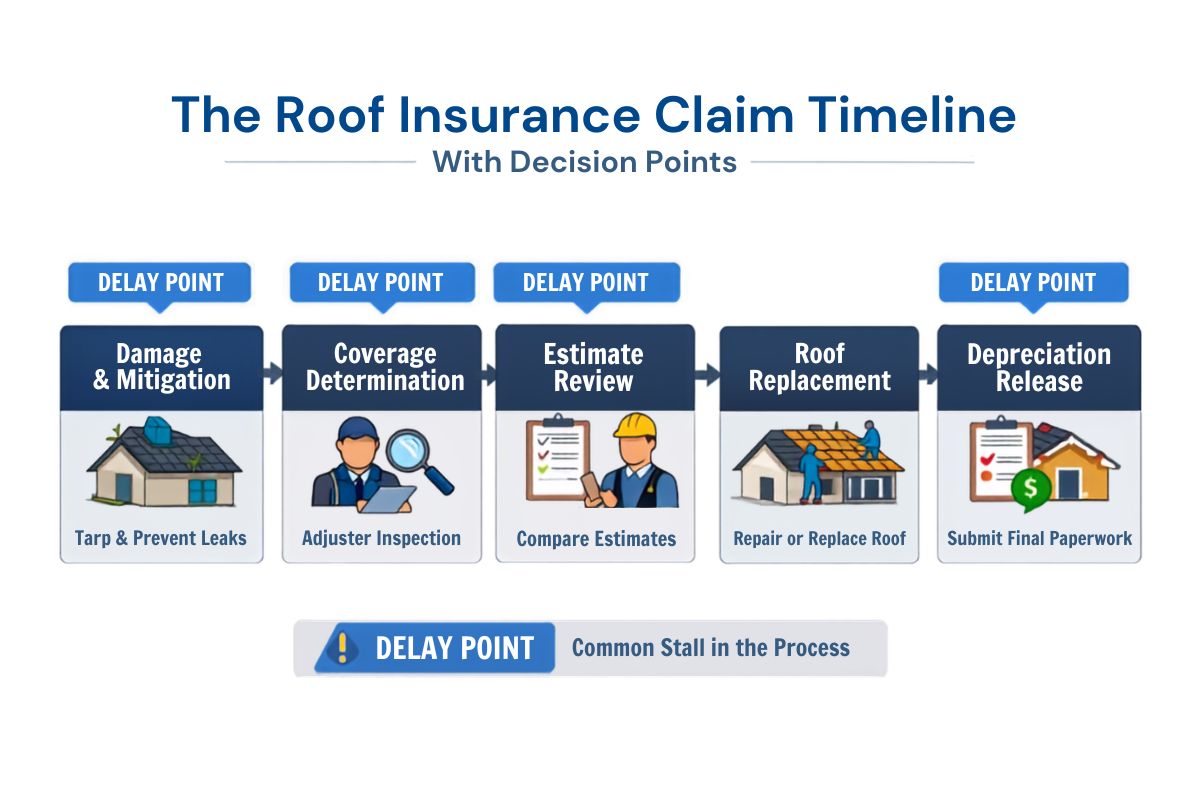
1. Damage and Mitigation
- A storm hits, shingles fly, leaks start.
- Within a day or two, most homeowners either tarp the roof or call a contractor to stop active leaks.
- Why it matters: Insurers expect to see this step. Skipping it can raise questions later about whether you let the damage get worse.
Get ahead of mitigation by reviewing our hail damage checklist.
2. Coverage Determination (First Stall Point)
- The claim is opened, and an adjuster inspects the roof (sometimes with a drone).
- This is the make‑or‑break moment: either the damage is confirmed as storm‑related, or it gets flagged as age/maintenance.
- If the adjuster isn’t convinced, the file often goes to a supervisor for review, adding weeks.
3. Estimate vs. Contractor Comparison (Second Stall Point)
- Once coverage is approved, the insurer issues an estimate.
- Homeowners usually bring in a contractor to compare.
- Rarely do the numbers match. That mismatch triggers a supplement: a revised estimate with documentation.
- Gathering photos, paperwork, and proof takes time. A thin paper trail can stretch a two‑week process into two months.
4. Roof Replacement
- After supplements are approved, the actual work begins.
- Crews typically finish in 1–3 days, depending on roof size and weather.
- This part is fast compared to the paperwork.
5. Depreciation Release (Third Stall Point)
- If your policy pays on replacement cost value, the insurer holds back part of the payout (called recoverable depreciation).
- To collect it, you must submit proof that the work was completed.
- Many homeowners assume the first check was the final payment and never send the paperwork.
The claim timeline has five steps, but only three real friction points:
- Coverage determination.
- The supplement process.
- Recoverable depreciation release.
Knowing these ahead of time helps you stay proactive, keep paperwork tight, and avoid watching your claim drift for months.
What to Do When the Settlement Seems Too Low
A denial or a lower-than-expected payout is not necessarily the final word. Insurance companies have formal processes specifically designed to handle these disagreements, and using them is a normal part of the claims process, not an adversarial escalation.
Here's the actual escalation hierarchy professionals use, in order.
1. Review the Scope Before Reviewing the Price
- This is the step almost everyone skips, and it's the one that matters most.
- Most disputes aren’t about numbers but about missing items. If the adjuster’s estimate doesn’t include all the necessary repairs, no amount of price negotiation will fix the gap. By carefully checking the scope first, you ensure the conversation is about the right work, not just the cost. This step alone often resolves the majority of disagreements.
2. Request a Line-Item Explanation
- Don’t settle for vague totals. Ask the insurer to explain each line item: why it was priced that way, or why it was excluded.
- This forces transparency and gives you a clear record of how the settlement was calculated. It also highlights inconsistencies that can be challenged with evidence.
3. Submit a Contractor Scope Comparison
- Put your contractor’s estimate side by side with the insurer’s.
- When the differences are visible in black and white, it’s harder for them to dismiss legitimate costs. This comparison shifts the conversation from opinion to documentation, which carries more weight in the claims process.
4. File a Supplement for Missing Items
- If you can prove that something was overlooked, whether it’s flashing, underlayment, or disposal fees, file a supplement.
- Supplements are the formal way to correct omissions, and insurers are obligated to review them. This step ensures you’re not paying out of pocket for essentials that should have been covered.
5. Request a Reinspection
- When the gap is significant, a second look at the roof can change the outcome.
- A reinspection allows another adjuster to physically verify damage that may have been missed the first time. It’s a practical way to reset the conversation with fresh evidence.
- If the disagreement is substantial enough, a second look at the roof is warranted.
Prepare for the adjuster visit with our DIY roof inspection checklist.
6. Invoke Appraisal
- If the process stalls, appraisal is the built‑in dispute resolution mechanism in most policies.
- Appraisal is a formal, policy-based dispute resolution process where each side selects an independent appraiser, and the two appraisers select a neutral umpire to settle disagreements.
- It's built directly into most policies for exactly this situation. It’s a structured, policy‑backed method to break deadlock fairly.
7. Bring in a Public Adjuster
- For complex or contentious claims, a public adjuster can level the playing field.
- They represent your interests exclusively, handle the paperwork, and negotiate directly with the insurer. Their expertise often shifts the leverage in your favor, especially when technical details are being debated.
8. Consult an Attorney
- There’s a difference between a genuine dispute over value and an insurer acting in bad faith, delaying responses without reason, misrepresenting policy language, or refusing to engage with clear documentation. When it crosses that line, legal counsel is the right move.
- Treating ordinary disputes as bad faith too early can backfire, but recognizing true bad faith protects your rights.
Mistakes That Cost Homeowners Thousands on Roof Claims
A handful of avoidable errors show up again and again across roof damage claims, and each one has a real dollar cost attached. Let's have a look at these mistakes:
- Waiting months to report damage, which invites questions about whether poor maintenance or the storm is the real cause.
- Discarding damaged shingles before documentation destroys physical evidence of the original loss.
- Accepting the first scope offered without any independent comparison.
- Signing a contingency agreement with a roofing contractor too quickly, before understanding what it actually commits you to.
- Failing to document interior damage like water stains and sagging drywall, which can strengthen the causation argument.
- Never learning what recoverable depreciation actually means, and simply not collecting it after the job is done.
- Ignoring ordinance or law coverage entirely and getting blindsided by code-upgrade costs later.
- Choosing the lowest-bid roofing companies without comparing scope, only to discover the "savings" came from skipped line items.
Pair smart claim strategies with the right roof financing plan to avoid hidden costs.
Conclusion
Don't walk away from this thinking "insurance is complicated." Walk away with the one insight that actually resolves most disputes: almost no roof claim disagreement is really about whether a storm happened. Adjusters, contractors, and homeowners typically agree on that part immediately. Where they diverge is repairability, scope, depreciation, code requirements, and pricing methodology- the 5 variables.
Homeowners who understand those five variables stop reacting to settlement letters and start evaluating them. That's the entire difference between accepting whatever number arrives first and negotiating toward what the roof and the policy actually owe.
If you're navigating a claim right now, our free Roof Replacement Cost Calculator can help you sanity-check whether a settlement offer is in a reasonable range for your roof's size and material.
And if you want a written, contractor-level scope of work to bring to your adjuster or to support a supplement, contact us and get a free, claim-ready roof inspection today.
How do adjusters determine whether a roof is repairable or requires full replacement?
They weigh material availability, brittleness from age, whether a patch would compromise watertightness, and whether matching requirements make a partial repair visually workable, not just how much damage is visible.
Why can two adjusters inspect the same roof and reach different conclusions?
Because causation and repairability involve professional judgment, not a fixed formula, training, experience, and interpretation of ambiguous damage patterns all factor in.
How are roof depreciation schedules calculated?
Based on the roof's age, material type, condition at the time of loss, and estimated remaining useful life, either as a percentage deduction or, increasingly, through a fixed payment schedule tied to age.
What are roof claim supplements, and when should they be submitted?
They're revised estimates covering items discovered after the original inspection, most often once the tear-off begins, and should be submitted as soon as new damage or missing scope is documented.
How do building code upgrades affect insurance settlements?
Ordinance or law coverage may be needed to pay for code-mandated upgrades like ice barriers or updated ventilation, which base policies don't always include automatically.
What documentation carries the most weight during a disputed roof claim?
Timestamped photos and video from immediately after the loss, historical weather data for that exact date, pre-loss maintenance records, and a detailed contractor scope comparison submitted in writing.
Roof Replacement Cost Calculator Accuracy: How Close Are Online Estimates to Real Contractor Quotes?