Roof Replacement Cost Calculator Accuracy: How Close Are Online Estimates to Real Contractor Quotes?
August 11, 2026
Ask a roofer about their calculator's accuracy, and they'll give you a confident percentage. But the number hides the truth. Accurate estimate compared to what? A calculator can nail your new roof's square footage to within a couple of percentage points and still miss your total cost by $6,000, because sq ft was never the part that was hard to estimate.
The better question is which parts of a roofing project can genuinely be estimated from a desk, and which parts require a person on a ladder. That distinction is the actual explanation for almost every gap homeowners see between an online estimate and a contractor's written quote. This blog works through that distinction section by section, including an honest look at where our own calculator's assumptions end and a real inspection has to begin.
Key Takeaways
- Roof cost accuracy isn't one number. It's four separate variables (measurements, material pricing, labor costs, and hidden repairs), and each behaves differently.
- Roof area and relative material pricing are the parts calculators get right most consistently. Roofing materials are priced by the square, equal to 100 square feet.
- Hidden conditions, like decking rot, cannot be priced by anyone, a calculator or contractor, until the existing shingles come off.
- Two roofing contractors can quote the same roof $5,000 apart without either one being wrong. The difference is almost always scope, not honesty.
- Calculators multiply the roof's surface area by the material cost per square foot.
- The most useful way to read an online estimate is as a benchmark for evaluating contractor quotes, not as a prediction of your overall cost.
How an Online Roof Cost Calculator Works, Step by Step
Roof replacement costs range from $6,700 to $25,000 on average, and calculators multiply the roof's surface area by material cost per square foot. For anyone who just wants the mechanics before the deeper explanation, here’s what our cost calculator shows in practice. A clear step‑by‑step estimate that turns broad ranges into tailored numbers.
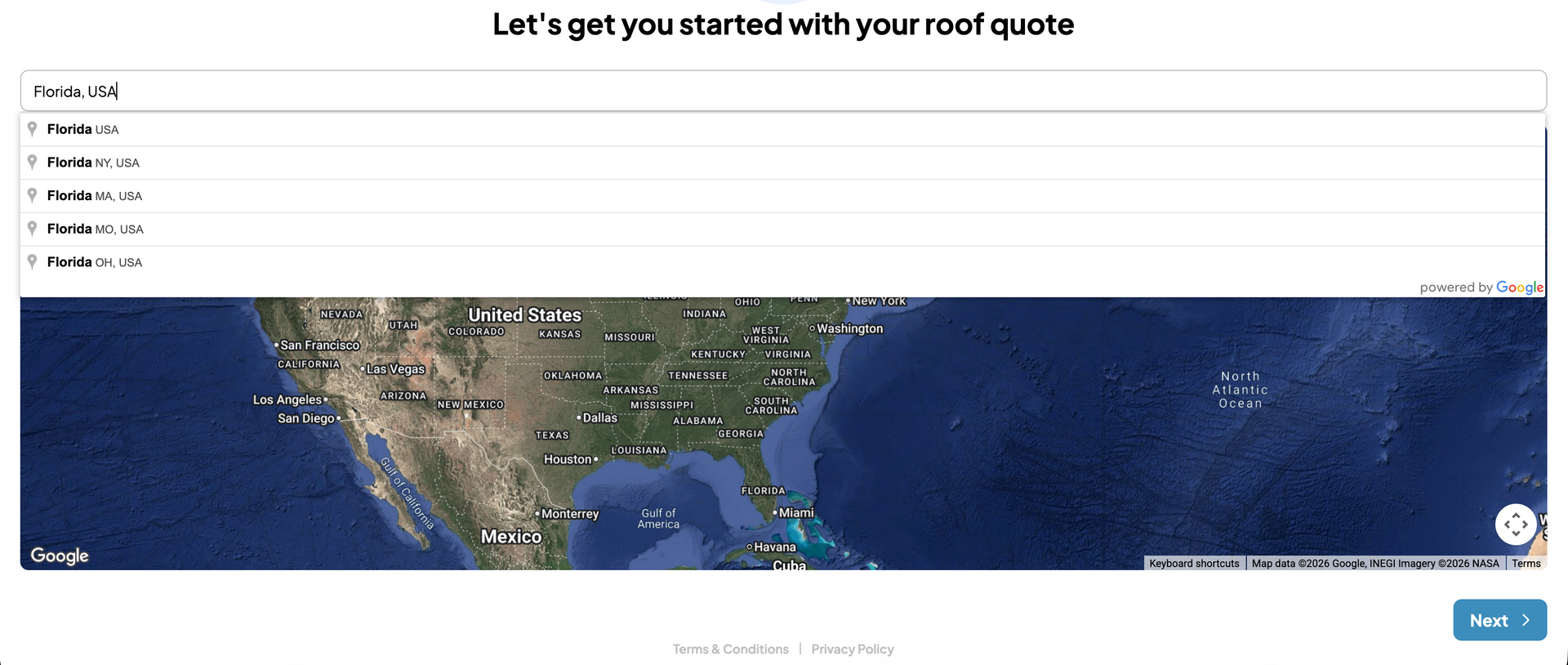
1. Enter your address
- The calculator uses this to retrieve satellite or aerial imagery and automatically map your roof's outline.
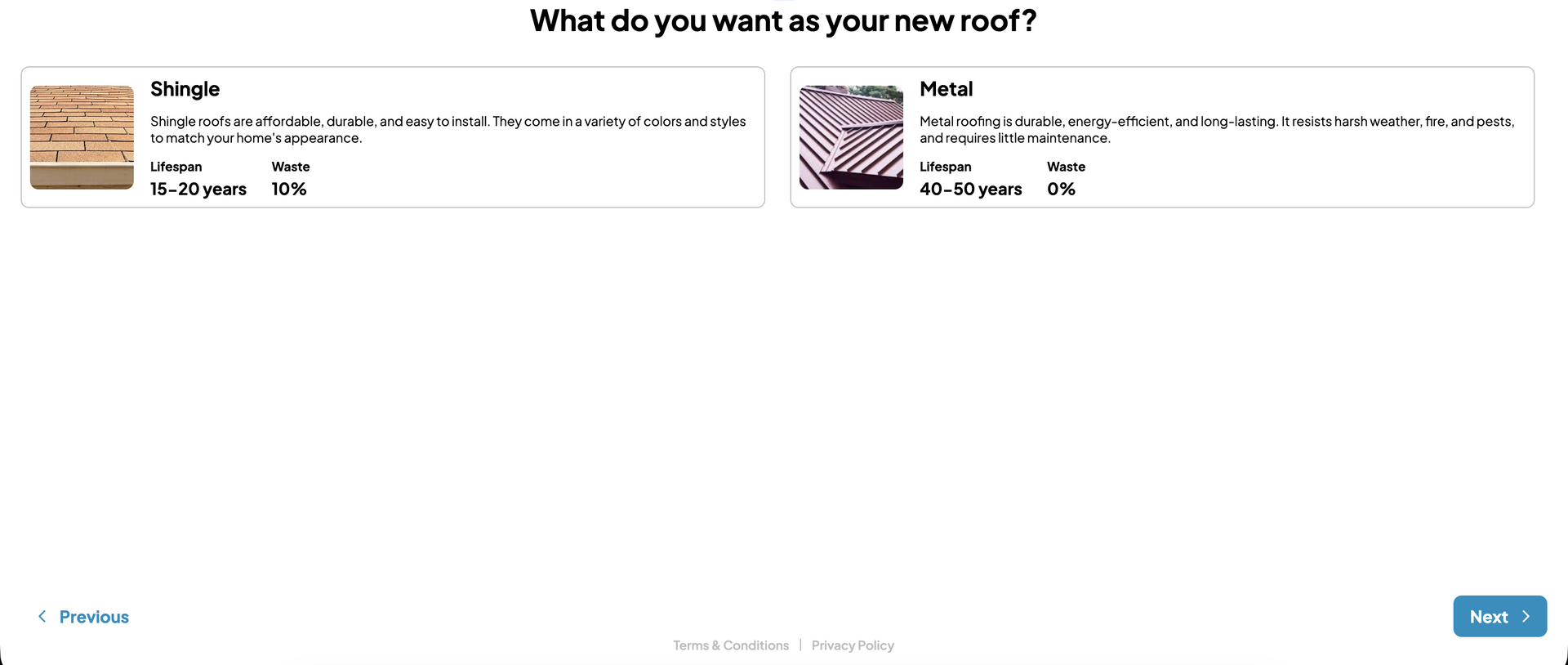
2. Select your material
- Choose asphalt, metal, tile, slate, or wood shingles to set the baseline for your estimate.
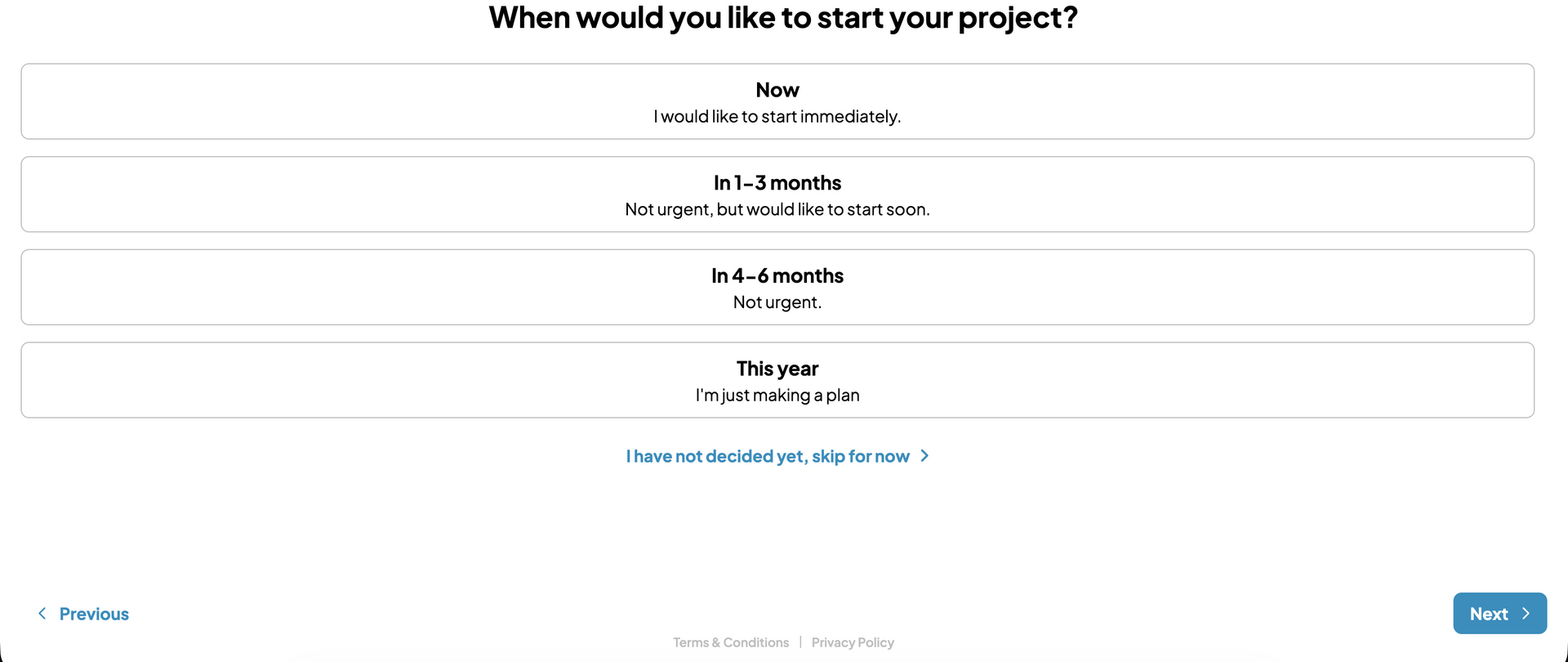
3. Pick your project start date
- Indicate when you’d like the work to begin so the calculator can align with seasonal labor rates.
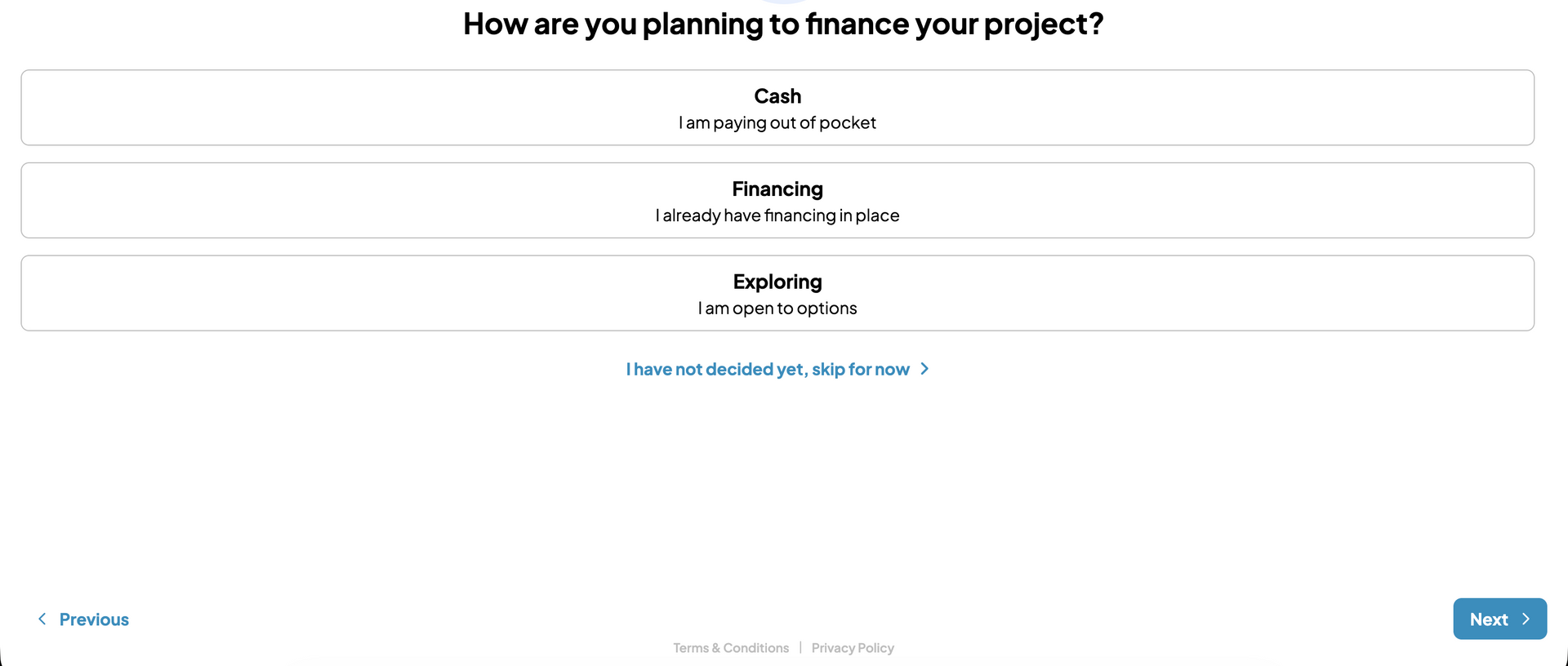
4. Choose your financing approach
- Note whether you plan to pay upfront, finance through a lender, or explore contractor payment plans.
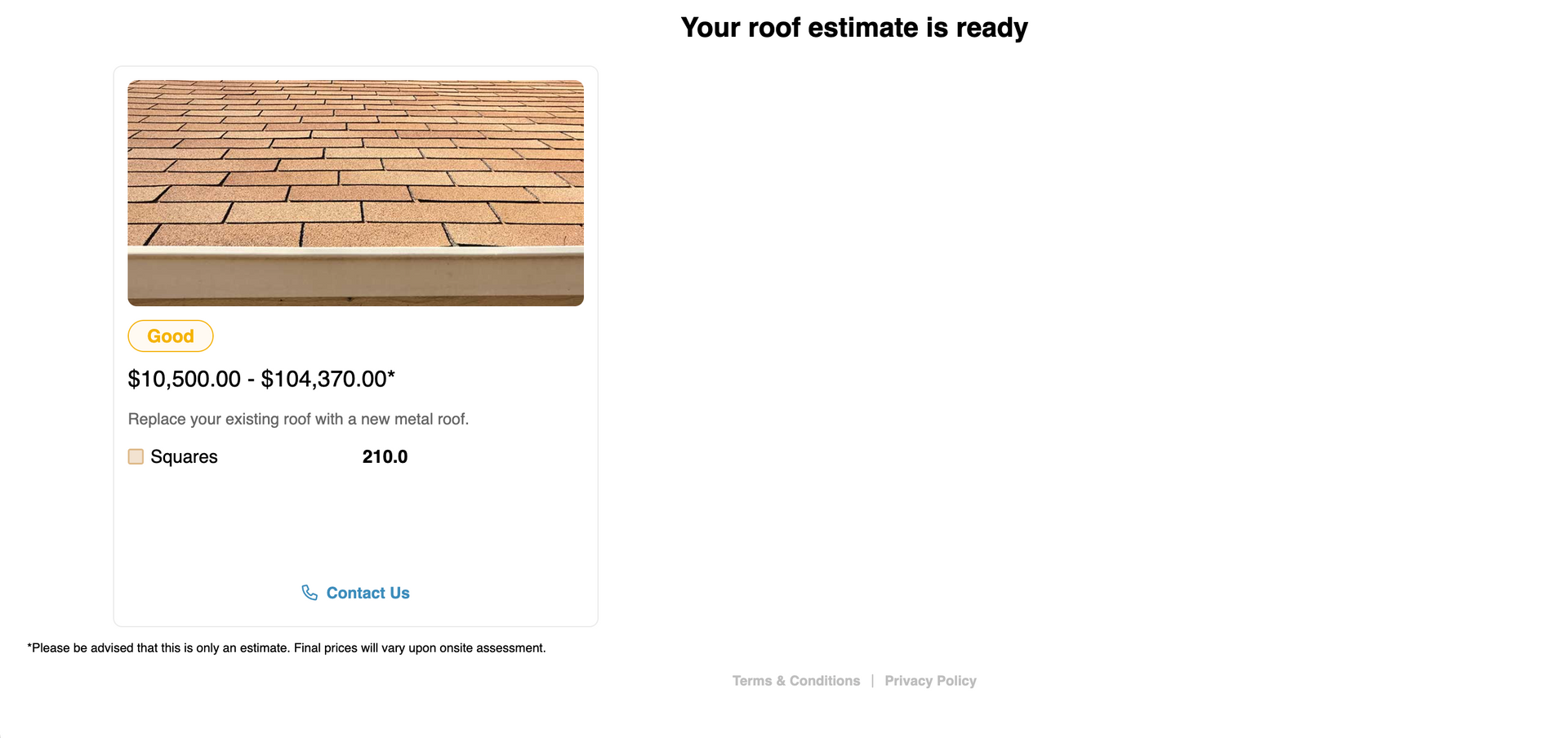
5. Receive your tailored estimate
- Enter your contact details and our calculator will combine your roof's measured area, your material choice, and a regional labor adjustment into a price range you can use to start budgeting.
The math behind that last step is simpler than it looks:
Total squares × (material cost per square + average local labor rate per square) = baseline estimate.
A "square" in roofing is 100 square feet of roof surface. A 2,400-square-foot asphalt shingle roof works out to 24 squares, and the calculator multiplies that by a combined material and labor rate per square to produce your range. That's the entire calculation. Everything else in this piece is about what that formula cannot account for.
Ready to test the math? Map your roof and get a baseline estimate in 60 seconds with our free roof cost calculator.
And because accuracy depends on the process, it’s worth reviewing how online tools calculate costs step by step; you can follow the full breakdown in this article.
Accuracy Depends on What You're Measuring
Ask a roofing company how accurate their online tool is, and you'll usually get a single confident number. That number is doing a lot of hiding. A full roof installation estimate is really four separate estimates stitched together, and they don't share the same margin of error.
| Variable | Calculator Accuracy | Why |
|---|---|---|
| Roof measurements | High | Built from satellite and aerial imagery, often cross-checked with GIS data |
| Material pricing | Medium to High | Drawn from regional pricing databases, though brand and grade get simplified |
| Labor costs | Medium | Estimated from averages; actual cost depends on a specific contractor's production rate and crew structure |
| Hidden repairs | Very low | Cannot be assessed without physically removing the old roof |
Once you split accuracy into these four buckets, a single accuracy percentage stops making sense. A tool can be genuinely excellent at the first row of that table, measurement, and still be structurally incapable of doing anything with the last row. That's not a bug to fix with a better algorithm. It's a hard limit to estimate a roof you haven't touched.
Quotes vary because calculators measure differently. Learn how roof replacement costs are estimated.
How Professional Roof Estimates Are Actually Built
This is the part that most homeowner-facing roofing content skips entirely, and it's exactly why two roofs with identical square footage can be priced thousands of dollars apart.
1. Roof geometry
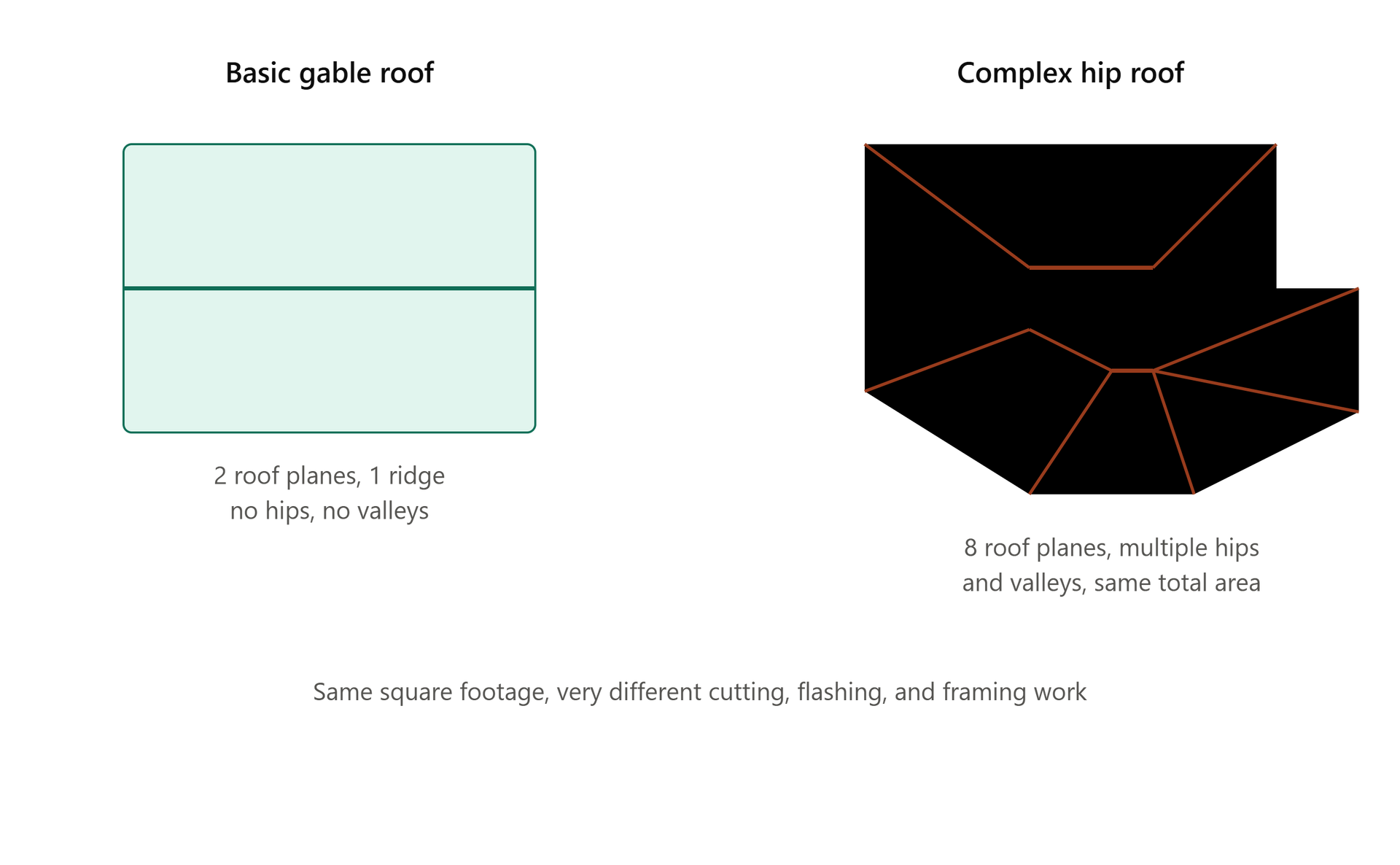
- A real estimate starts with more than footprint and pitch. It accounts for hips, valleys, dormers, and penetrations, chimneys, skylights, vent stacks, each of which adds cutting, flashing, and detail work that a flat square footage number cannot capture.
- A simple gable roof and a cut-up hip roof can carry the same square footage and still differ by 25% to 40% in labor hours because roof type and complexity drive that difference, not size. A calculator that only asks for square footage and material has no way to see it.
2. Scope of work
- A professional quote isn't pricing "a roof." It's pricing a defined, written scope.
- A properly itemized estimate lists tear-off (removing old shingles down to the decking), a decking allowance for necessary repairs, the roof's underlayment type, ice barrier, drip edge, flashing (replaced or reused), ridge ventilation, pipe boots, starter shingles, ridge cap, cleanup, and disposal costs, as separate line items.
- Most online calculators fold all of that into a single blended cost-per-square-foot figure, which is a reasonable simplification for a fast, free ballpark estimate, and also exactly where two contractor quotes for the same job start to diverge.
3. Production rates.
- Every roofing business prices labor around what its specific crew can install in a day, and this number varies more than most homeowners assume. Roofers typically charge $130 per hour for labor. And labor costs account for 40% to 60% of total roof replacement costs alone.
- Industry benchmarks put an experienced four-person asphalt crew at roughly 15 to 25 squares a day on a standard-pitch, low-complexity roof. Put that same crew on a steep, cut-up roof with multiple penetrations, and daily output can drop to something closer to 8 to 12 squares.
- Two contractors bidding for your roof may simply be running different production rates for reasons that have nothing to do with honesty, crew experience, equipment, or how the dumpster gets staged.
- Almost no consumer-facing calculator models contractor-specific productivity. It uses a blended regional average instead, because it has no way to know which crew will actually show up at your house.
If you want to understand how calculators turn unpredictable factors into reliable numbers, check out the benefits of using one before your next roof replacement at this link.
Where Online Calculators Are Surprisingly Accurate
To know how the roof replacement cost calculator works, it's worth being specific about where these tools hold up, rather than treating "estimate" as a synonym for "guess."
1. Roof area
- This is the strongest link in the chain. Modern aerial imagery, the kind behind measurement providers like EagleView, Nearmap, and RoofScope, regularly lands within a few percentage points of an on-roof, tape-measure result.
- Many professional contractors use these same aerial services themselves rather than climbing every roof before bidding, which is a reasonable signal that the underlying technology holds up. Where accuracy drops is in pitch. A straight overhead image struggles to capture how steep a roof actually is, which is why simpler tools ask you to select a pitch manually, and more advanced ones rely on multi-angle or 3D imagery to calculate it directly.
2. Relative material pricing
- Calculators are reliably good at capturing the relationship between different roofing materials, even when they're less precise about exact dollar amounts.
- Our internal query data shows asphalt shingles as the most stable material, with estimates aligning within about 5% of reality. Metal roofing introduces more volatility, swinging 12%-15% depending on profile complexity. Tile and slate climb higher still, while wood shingles bridge the middle. The hierarchy repeats across regions, proving asphalt is the anchor against which every other material is priced.
- Reflective or cool roof options can shift the number further, since the material or coating adds upfront cost but can lower energy bills over time, which is a separate calculation from replacement cost alone. Material choice also shapes curb appeal, which matters if you're weighing options for reasons beyond cost.
3. Budget planning
- The actual value of an online estimate was never precise to the dollar. It's preventing a homeowner from mentally budgeting $8,000 for a job that will realistically run closer to $20,000.
- Getting the right order of magnitude, instantly and for free, is what makes these tools worth using, even though nobody should treat the number as final.
Accuracy depends on the inputs, but some estimates are spot‑on. Learn more in the roof calculator accuracy insights.
Where Calculators Consistently Break Down
These aren't software failures. They're the physical limits of estimating a structure without inspecting it, and it helps to separate them by where the uncertainty actually comes from.
1. Unknown structural conditions
- Rotten decking, wet insulation, hidden leaks, and fascia damage sit inside or underneath the roof system, invisible to aerial imagery. Neither a calculator nor a contractor bidding from the ground can confirm necessary repairs until the old roofing material is physically removed. This is the single largest source of extra fees between an initial estimate and the final invoice. Inspect roofs annually to assess repair or replacement needs. A new roof can recoup over 60% of its cost at resale. But installing new shingles over old ones can save on removal costs.
2. Roof complexity
- Valleys, hips, intersecting planes, skylights, chimneys, solar panels, and satellite dishes each add labor time individually, and the effect compounds rather than adding up in a straight line. Pricing guides commonly apply complexity adjustments of 10 to 40 percent above a simple roof's base labor rate, depending on how many features are present. Roof type alone, gable versus hip versus mansard, can shift that adjustment before any single feature is even factored in.
3. Access constraints
- A narrow driveway, no room for a dump trailer, steep landscaping, a multi-story elevation, HOA restrictions, or a tight urban lot can all slow a crew down measurably, and every bit of that is invisible from a satellite image. Steeper roofs require more safety equipment and labor, increasing costs.
4. Local labor markets
- Roofing is a local labor market, not a national one. A contractor in a high-cost-of-living metro carries different overhead, and therefore higher labor costs, than one in a smaller regional market. Even within the same city, two licensed contractors can carry different insurance costs, crew composition, and subcontractor pricing that shift their labor rate independently of skill or finished quality.
5. Building code triggers
- Certain requirements only activate during a full replacement, not routine maintenance, and a generic calculator has no way to know a specific municipality's rules.
- Common examples include ice barrier requirements in colder climates, ventilation upgrades to meet current code, updated nail patterns for wind rating, local permits tied to project scope, and drip edge compliance. A contractor working in your area prices these in from the start.
Before relying on an estimate, learn from "Roof Replacement Cost Estimator: How Accurate Are Online Tools" on how calculators can misrepresent real costs.
Why Two Contractor Quotes Can Differ by $5,000 on the Same Roof
Go back to the 24-square asphalt shingle roof from the calculator math above. A homeowner gets two quotes for the same job. Contractor A comes in around $14,500. Contractor B comes in around $19,800, a $5,300 gap on the same roof. The homeowner's first instinct is usually that one number is wrong. Most of the time, neither is. They're pricing two different scopes under the identical label of "roof replacement."
Line up the two quotes and the gap usually breaks down into something like this:
| Feature | Contractor A | Contractor B |
|---|---|---|
| Flashing | Reuses existing flashing around chimney and valleys | Replaces all flashing entirely |
| Underlayment | Standard felt underlayment | Synthetic underlayment, higher upfront cost but longer lifespan |
| Decking | Prices replacement separately if rot is discovered mid‑project | Includes a ten‑sheet decking allowance directly in the quote |
| Permits | Excludes permit fee | Includes permit fee |
| Labor | Faster production rate on simpler roofs | Smaller, meticulous crew with higher per‑square labor rate |
Individually, none of these differences is dramatic. Stacked together, they add up to a five-figure gap that has nothing to do with either contractor being dishonest, and everything to do with two defensible decisions about what "replacing your roof" actually includes.
Comparing Calculator Estimates Against Real Quotes
Rather than the generic advice to "get multiple quotes," it helps to have a rough framework for what a given gap between your calculator estimate and an actual contractor quote is likely telling you.
| If a contractor's quote is... | Likely explanation |
|---|---|
| 5% to 10% higher than the calculator | Normal local labor rate difference |
| 10% to 20% higher | Scope differences (tear-off layers, underlayment grade, flashing) |
| 20% to 35% higher | Roof complexity, access constraints, or a decking allowance built into the price |
| 35% or more higher | Discovered structural repairs, code-required upgrades, or a significantly more complete scope than the calculator assumed |
This isn't a precise diagnostic; individual jobs vary too much for that, but it's a reasonable first filter before assuming something has gone wrong. Back to the 24-square case above, Contractor B's quote was roughly 37 percent higher than Contractor A's, which, per this framework, points toward scope and built-in allowances rather than an error on either side. That matches what the line-item breakdown actually showed.
A quote that sits dramatically above every calculator range for your roof's size and material is worth a direct conversation about what's driving it. It's not automatically a red flag, but it's not something to sign without asking.
Curious how close calculators come to reality? Check the roof replacement calculator vs manual estimation.
How to Evaluate a Contractor Quote Using a Calculator
The most useful role for an online estimate isn't predicting your final price. It's giving you a benchmark to evaluate the quotes you actually receive. Before comparing total price, get each contractor's contact details and full written scope, then confirm they're answering the same questions:
- Same material, brand, and specific product line
- Same warranty length and coverage, both manufacturer and workmanship
- Same ventilation approach
- Same flashing scope, replaced versus reused
- Same tear-off scope, single layer versus multiple layers
- Same permit handling, included versus billed separately
- Same cleanup, disposal fees, and dump terms
- Same decking allowance and per-sheet replacement rate if rot is found
Once quotes are aligned on these eight points, comparing the bottom-line number actually tells you something. Comparing unaligned quotes on price alone is comparing two different projects that happen to share the same three words: "roof replacement estimate."
You can strengthen your evaluation by learning how to compare roofing quotes using a roof replacement cost calculator, which shows whether a contractor’s price aligns with realistic estimates.
How Our Roof Cost Calculator Handles These Uncertainties
We built ours around a few specific, deliberate choices rather than a claim of precision it can't actually deliver.
- It returns a price range tied to your material and roof size, not a single fixed figure. A single number implies a certainty that no remote tool can honestly provide.
- It applies a regional adjustment based on your geographic location instead of a flat national average, since labor rates shift as much by market as they do by material choice.
- It discloses its own assumptions in plain language, including that the estimate does not account for decking replacement, roof complexity beyond basic pitch, or site access conditions.
- It states outright what it excludes: permits, code-triggered upgrades, and anything that can only be confirmed by walking the roof in person.
A roof replacement is one of the larger home improvement costs most homeowners take on, so we'd rather hand you a defensible range than a false single number. A calculator that hides its assumptions can look more impressive on screen. One that discloses them is more useful the moment you're sitting across from an actual contractor's written quote, which is the moment that actually matters.
Visit now to see how numbers add up and save money: Roof Replacement Cost by Location, Roof Type & Material
Conclusion
The largest gap between an online roof estimate and a contractor's final quote rarely comes from measurement error. Roof area, the part calculators are genuinely good at, is usually close to right from the start. The real gap comes from scope decisions, labor assumptions, and physical conditions that cannot be observed from a desk, including decking, complexity, access, and local code requirements, chief among them. Whether you're planning to re-roof this year or just gathering numbers for next spring, understanding those variables individually will tell you more about the real cost to replace your roof than chasing a calculator that advertises 99% accuracy, because no honest tool can make that claim and mean all four variables at once.
The most reliable way to use a calculator is exactly how it's meant to be used, as a starting point for budgeting and comparison, followed by real quotes from licensed local contractors before you commit to anything.
Get a realistic starting range with our free Roof Replacement Cost Calculator. It's built on a real range instead of a false single number and disclosed assumptions, and a clear picture of what it can't see.
When you're ready for numbers based on your actual roof, contact us to schedule an in-person inspection and get a detailed, written quote.
Why can two contractors measure the same roof but produce different quotes?
Measurement is rarely the source of the difference. The gap almost always comes from scope, meaning what's included (flashing replacement, underlayment grade, decking allowance, permits) and the contractor's specific labor rate and production speed, not from disagreement about the roof's actual size.
What is a reasonable percentage difference between an online estimate and a contractor quote?
A gap of 5% to 20% is common and usually reflects normal local labor rates or standard scope differences. Gaps beyond 35% are more often explained by discovered structural repairs, code-required upgrades, or a materially more complete scope than the calculator assumed.
Do contractors use the same aerial measurement technology as online calculators?
Many do. Services like EagleView, Nearmap, and RoofScope are used by both consumer-facing calculators and professional contractors, which is part of why roof area tends to be one of the more reliable parts of an online estimate.
Why isn't roof decking included in online estimates?
Because the decking condition can't be confirmed until the old roofing material is physically removed. This applies to every estimating method, not just online tools. A contractor working from the ground faces the same limitation, which is why decking is typically priced as an allowance rather than a fixed cost. Removing old roofing can add $100-$150 per square to costs.
Are roofing estimates based on square footage alone?
No, though square footage is the starting point. A complete estimate of the roof depends on factors such as pitch, roof geometry, material grade, tear-off requirements, and site access, all of which affect labor time independently of total area.
How do roofing companies calculate waste factors?
Waste factors account for material lost to cutting, overlap, and roof shape. Simple roofs typically carry lower waste percentages, while roofs with more hips, valleys, and cuts require more material than the flat square footage alone would suggest.